
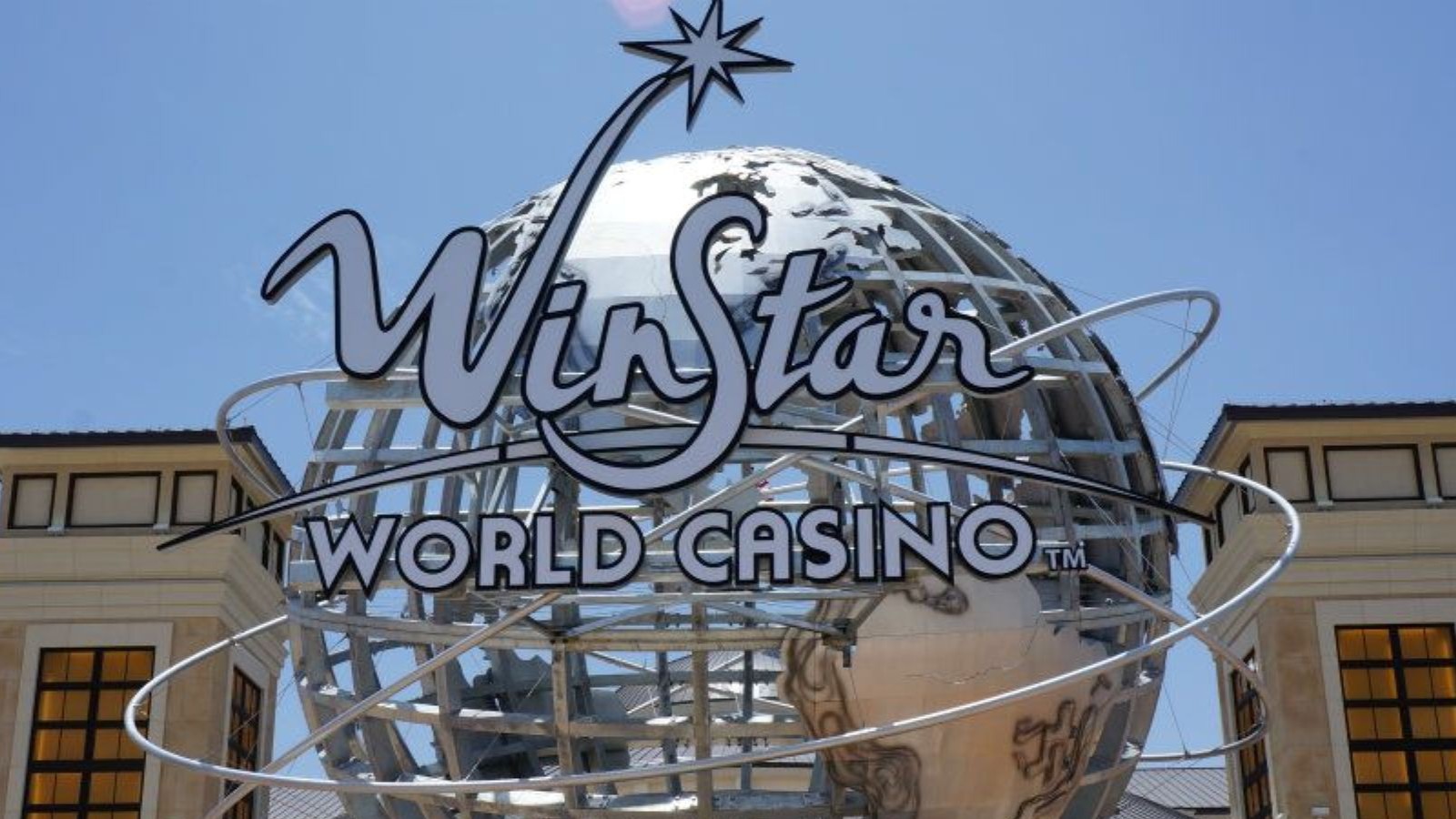
- With no legal casinos at home, Texans are estimated to spend billions of dollars a year at Oklahoma casinos, most of it at two resorts just over the Red River from Dallas-Fort Worth.
- WinStar World Casino, owned by the Chickasaw Nation, sits at the first Oklahoma exit north of the Texas line and has the largest casino floor in the country, drawing most of its visitors from North Texas.
- Analysts say Oklahoma’s border casinos depend so heavily on Texas that a legal Texas casino market would force them to shut down or scale back.
- Since 2006, the Chickasaw and Choctaw nations have given more than $5 million to Texas officeholders and candidates, and the Associated Press has reported that out-of-state operators have donated to help keep gambling out of Texas.
- Texas remains one of the most populous states with no commercial casinos and no legal sports betting, a status that has made its neighbors rich.
THACKERVILLE, Okla. – This town of a few hundred people exists because of the casino at its edge, and that casino exists because of Texas. At the first highway exit north of the Red River sits WinStar World Casino, and most of the people walking its mile-long floor drove up from Texas to get there.
That is the arrangement that has defined gambling in the region for two decades. Texas bans commercial casinos and has no legal Texas sportsbooks, so Texans drive north, and the Oklahoma casinos near Texas collect the difference. The numbers are large, if imprecise. Clyde Barrow, a gambling-policy scholar at the University of Texas Rio Grande Valley, has estimated that Texans spend between $2.5 and $3 billion a year at Oklahoma casinos alone, and roughly $5 billion a year once Louisiana, New Mexico and Las Vegas are added in. No casino discloses where its customers live, so these are modeled estimates built from license-plate surveys and revenue data rather than exact counts, but every analyst who has studied it agrees the flow runs overwhelmingly one direction: out of Texas.
The geography is the entire business plan. WinStar, owned by the Chickasaw Nation, has the largest casino floor in the country, bigger than anything on the Las Vegas Strip, with more than 10,000 electronic games, roughly 100 table games and three hotel towers. It sits about 75 miles and an hour’s drive from Dallas-Fort Worth, and draws most of its visitors from North Texas. An hour east, the Choctaw Nation’s flagship resort in Durant, about 90 miles from Dallas, tells the same story. The tribe has said the bulk of its customers are Texas residents, and it poured roughly $600 million into an expansion built to pull in more of them.
Take the Texans away and the model collapses. Mark Jones, a political scientist at Rice University’s Baker Institute of Public Policy, has said that without Texas visitors most of the casinos in southern Oklahoma would not be economically viable, and that if Texas ever legalized casinos in Texas, those border resorts would begin shutting down or scaling back. The American Gaming Association put it in plainer institutional terms, naming potential legalization in Texas as the single biggest competitive threat to Oklahoma’s gaming market.
So the tribes have a clear interest in keeping Texas closed, and the record shows they have spent to protect it. Since 2006, the Chickasaw and Choctaw nations have given more than $5 million to Texas officeholders and candidates, according to an Associated Press review, and the AP reported that casino operators from neighboring Oklahoma and Louisiana have donated millions to help keep gambling out of Texas. Jones has described the logic without softening it: the more the tribes invest in casinos aimed at Texas, the harder they work, through campaign donations and lobbying, to keep Texas from opening its own.
Meanwhile, Texas stays shut. It remains one of the most populous states with no commercial casinos and no legal sports betting. Under Texas gambling laws, expanding gaming requires a constitutional amendment, which means a two-thirds vote in both legislative chambers followed by approval from voters, and repeated efforts to legalize casinos and sports betting have died without ever reaching the ballot. The result is a closed market ringed by open ones, with the demand intact and the supply waiting just across the river.
For Oklahoma, the payoff is enormous. Tribal gaming is among the state’s largest industries, and a study commissioned by the Oklahoma Indian Gaming Association found that Oklahoma’s tribal nations contributed $23.4 billion to the state’s economy in 2023, with gaming the single largest contributor. Oklahoma has more tribal casinos than any other state. Much of that prosperity rests on a customer base that lives in another state and has nowhere closer to go.
None of it is hidden. The Chickasaw built a town-sized resort on the first patch of Oklahoma a Texan reaches driving north and filled it with the slot machines and table games Texas will not allow at home. Every legislative session that ends without action in Austin is another two years the arrangement holds. For now, the safest bet in Texas gambling is that the money keeps heading north.