
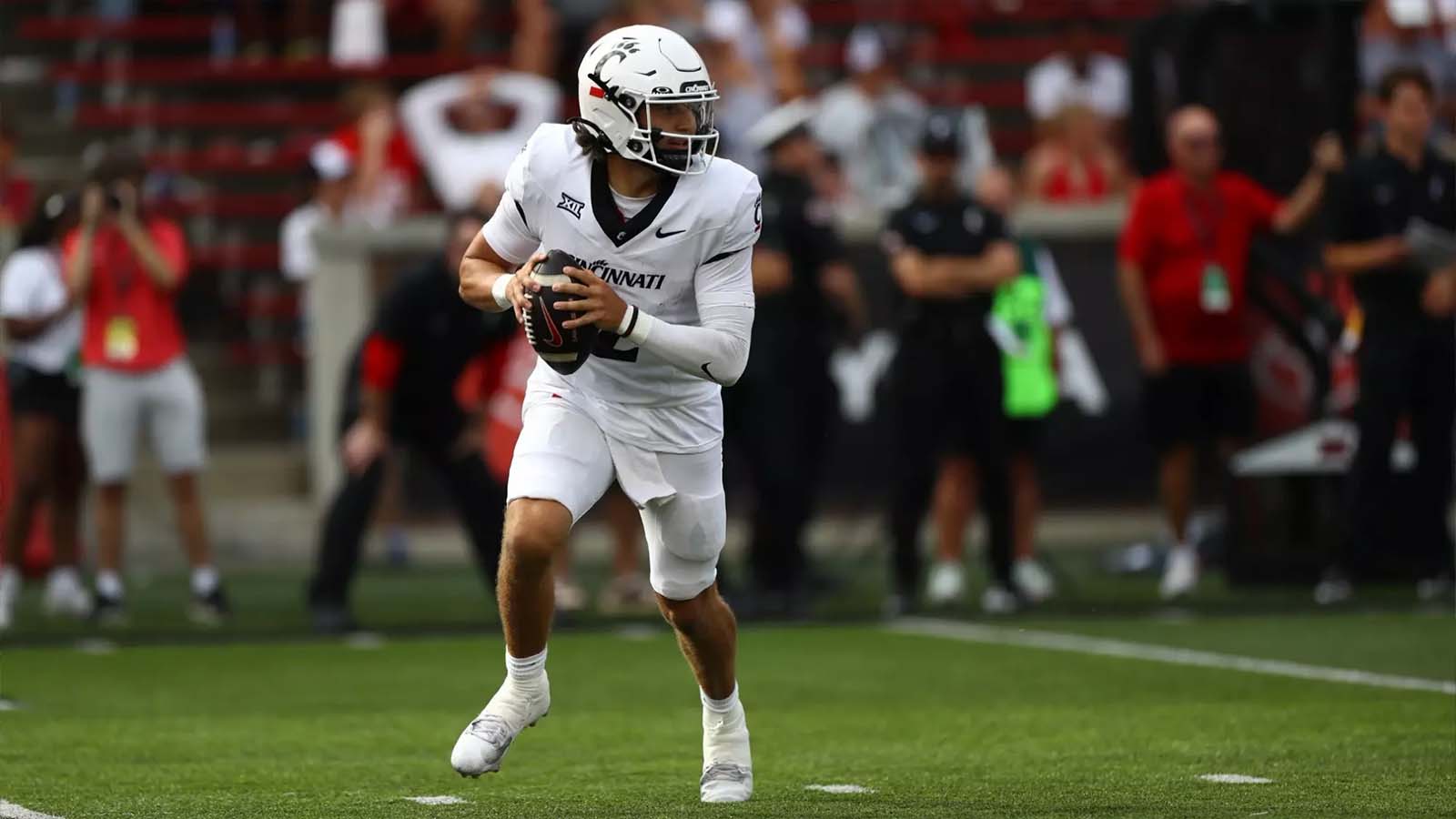
The Red Raiders’ new starter stayed away from his own hearing while attorneys fought over whether a four-year betting habit should cost him the season before it starts.
- More than 2,900 bets and $30,000 ran through Sorsby’s Indiana years, 40 of them on the football team he suited up for, and his career tally sits past $90,000
- Senior Judge Ken Curry could decide as soon as June 15 whether to grant the injunction that would clear Sorsby for the 2026 field
- His lawyers say the NCAA owed him treatment of a clinically diagnosed gambling disorder as a health matter, and skipped that step
- Sorsby’s defense pairs Jeffrey Kessler, who engineered the landmark House v. NCAA antitrust settlement, with Dustin Burrows, the current Texas House Speaker
LUBBOCK, Texas. The call belongs to a judge now. The two sides traded arguments for two hours Monday inside Lubbock County’s 99th District Court, and Senior Judge Ken Curry walked out without ruling. He should have an answer within days. What Sorsby wants is narrow: a temporary injunction that lets him suit up in 2026 while his suit against the association grinds forward. He skipped the hearing entirely.
The Wagers Behind the Case
His Indiana ledger runs past 2,900 bets and $30,000, piled up between June 2022 and December 2023, his two seasons taking snaps for the Hoosiers. Forty of those rode on Indiana football. Another 40 or so went to Indiana men’s basketball, with close to 300 spread across other college football games. Add up the whole college run and the number clears $90,000.
It all stayed quiet until March 11, 2026, when an online betting site flagged the activity. Police had tipped the book off. Texas Tech caught wind of the probe on April 14. By April 27 the school had sidelined him indefinitely, and he entered Algamus, a residential facility in Goodyear, Arizona, for a 35-day stay. His diagnosis: an anxiety disorder and a gambling addiction.
A Texas Twist
Here is where it turns local. Sorsby kept right on betting after his move to Texas Tech, a campus planted in a state where mobile sportsbooks are simply against the law. Court filings say he used accounts that belonged to a relative and to friends. Texans who bet know the drill. No legal app to download means the workaround is the market.
That won’t loosen up anytime soon. Lawmakers don’t gather again until January 2027, and Lt. Gov. Dan Patrick has spent years keeping any betting bill choked off in the state Senate. A wall of House Republicans likes it that way. Residents are left with a grab bag of offshore books, out-of-state proxies, sweepstakes casinos, and prediction markets like Kalshi and Polymarket. Our rundown of Texas sportsbooks walks through what’s actually reachable.
How the Hearing Played Out
Leading the defense is Jeffrey Kessler, fresh off the House v. NCAA case that rewired college sports. Beside him sits Dustin Burrows, who runs the Texas House as its Speaker. The case reached Curry only after the judge first assigned to it, Phillip Hays, bowed out because of his connections to the school. Curry, retired from the Tarrant County bench, picked it up from there.
Kessler’s pitch leaned on intent. His client, he argued, never gambled to make money and never bet on any game he took the field in. “Based on these facts, there can be no doubt that there was no competitive integrity issue,” Kessler said. The filing itself swings harder, charging that the association “weaponized his condition to shore up a facade of competitive integrity, while simultaneously profiting from the very gambling ecosystem it polices.”
NCAA counsel Taylor Askew waved the health argument off. “If this were just one or two violations, it would still render him ineligible. This is thousands of violations,” Askew said, pointing to the “40 individual bets” Sorsby placed on Indiana’s football games while he held a roster spot but wasn’t traveling with the squad. A player in that spot, he argued, draws the same outcome as anyone else: “permanent ineligibility.” Askew also worked the timing, painting Sorsby as a serial offender who reached for the addiction defense only once the investigation broke open.
The University Won’t Back Down
Lawrence Schovanec, the university’s president, has backed Sorsby out loud and says Tech is fighting the NCAA’s refusal to reinstate him. The school filed its appeal on May 29 and asked the association to trade the lifetime ban for a two-game suspension. Schovanec laid out his reasoning in a public letter, framing the case against a bigger shift: “As a generation of college athletes face the legalization and rapid proliferation of sports betting in our country, gambling addiction is rising to the point of epidemic among college aged men in particular. The NCAA’s stated mission includes ‘fostering (student-athletes’) lifelong well-being.’ Gambling addiction is a clinically recognized behavioral disorder, as defined in the DSM-5.”
Joey McGuire hasn’t blinked either. “I do believe that there should be consequences, but it’s my opinion that he shouldn’t be penalized for the rest of this year of his whole career,” the head coach said at the conference’s spring meetings. He has praised Sorsby for checking himself in and pledged the program will stick by him. Sorsby got to Lubbock this offseason on an NIL deal reported in the millions, after ESPN tabbed him the nation’s top transfer back in January.
What a Ruling Does, and When
Curry wants more paperwork from both camps and made clear a decision is near. Kessler pressed for June 15, a week before the window closes June 22 on the NFL’s supplemental draft. That route is the backup if the injunction falls through.
An injunction wouldn’t wipe the ineligibility away. It would freeze it while the lawsuit runs its course. The association has already signaled it has no plans to settle with Sorsby’s side. However Curry rules, an appeal can follow, and that would land at the Texas Seventh Court of Appeals, where every one of the four sitting justices holds a law degree from Texas Tech.